About 2 weeks ago, I decided to acquire some Early Music and finally make that leap back even earlier in history. I wanted something which expresses the strong Christian influence (ironic considering my opinions of religion) on the music without being entirely choral.
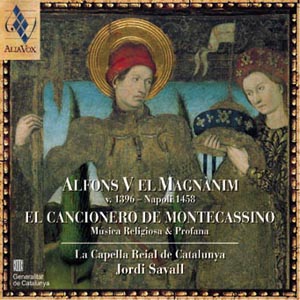
In Michaels Music Room I picked up a copy of Alia Vox's double CD release of Early Music: "Alfons V el Magnànim: El Cancionero de Montecassino". The music is performed by Le Capella Reial de Catalunya, which includes Jordi Savall, Montserrat Figuraras and Arianna Savall among others, I knew the recording and performance would be spectacular (and it is).
The first thing I noticed was the absence of vibrato (a big plus in my book, as I generally dislike it): any lines by any voice, whether sung or played by an instrument are clearly held and sustained. The combination of this technique with the Viola Da Gamba and choral singing is just awe-inspiring: the notes are so clear, so evidently identifiable; you can almost see them in your mind. It's also really interesting to hear "proto-counterpoints" heralding the coming of JS Bach several hundred years later when this technique would be perfected.
As an enthusiast of the Viol, I noted that the Gamba's role is even more aligned with the human voice than in the Baroque period (I now realise that they separated as the art of virtuosic playing evolved). It's said that the Gamba was the instrument which could emulate the sounds of the human voice more than any other. This is displayed here with such success that were it not for the texture of the bow across the strings, one is almost unable to differentiate the Gamba from the soprano or tenor's voices.
As with any kind of music, Early Music depicts cultural events or characteristics of the period: Europe underwent massive transformation during the 14th century due to famines, plagues and climate shift (a mild Ice Age). Massive under population combined with conflicts and divisions within the Church paints a picture of Europe's darkest period in history. Thus, the music of the period reflects Christian devotion to Christ through darker tones.
Some of the darkest laments I have heard have been on Andreas Scholl's Kantate. But musically around 200 years earlier, Europe's blackness is expressed with incredibly moving singing, depicting an eternal lament of Christ's death and the solemn celebration of his reign in the world at the time. It is a haunting, raw and beautiful depiction of the devotion to religion, and of a Europe struggling to get back on its feet enhanced by the linearity of the singing and playing techniques in the music.
I "half knew" what to expect when listening to this CD (my first "true" experience with Early Music). With my knowledge of Baroque behind me (combined with various attendances at Baroque concerts, and the fact that I have the best Baroque teacher in Linda), interpreting Early Music is becoming a far more interesting experience than I could have first imagined because of the comparisons and evolutional aspects I can draw on. I think if I had gone the other way around (exploring in a chronological manner), I might not have appreciated the more refined or "simplified" aspects of Early Music as having the purpose it does.
I'm truly excited by this music. I haven't felt this moved since listening to some Finnish mood-crushing Funeral Doom (Shape of Despair's "Shades Of..."), but the difference here in Early Music is that this darkness is real, not fantasy.
Through this music, history has been clearly expressed in ways that books can only tell part of the story with. In the "Cancionero de Montecassino" manuscripts, the songs of Christ’s Heaven and the laments of a dying Europe come alive through modern means, teaching us how we have arrived to where we are today. I'm looking very forward to pursuing this new musical avenue with even greater depth, to discovering even more links of musical evolution across time.

No comments:
Post a Comment